Showing posts with label bird food. Show all posts

Friday, 7 March 2014

Spring Sale is extended through to April


We've extended our Spring Sale on Peanuts & Sunflower Hearts throughout March & April.
You can now buy 25kg of Economy Peanuts for just £39.99 & 25kg of Premium Sunflower Hearts for just £38.99
Follow the links above now to place your order or call the office on 01778 342665.
All orders over £50 qualify for a 5% discount so why not browse around our bird feeders & live bird feed to add to your order?

Monday, 14 October 2013

'Early birds' find worms for dinner - BBC Nature

We've just spotted this really interesting article about the feeding habits of wild birds on the BBC website and thought it would be good to share with you ...


Birds, such as great and blue tits, search for food in the morning but only return to eat it in late afternoon, scientists have found. The team believe the behaviour maximises their chances of avoiding predators during the day without starving to death overnight. Researchers from the University of Oxford tracked the birds' winter foraging movements using tiny tags.

All five of the studied species of songbirds behaved in the same way. The results are published in the Royal Society journal Biology Letters.

"Our results are important because they provide a new hypothesis for how animals forage," said Damien Farine, lead author from the University of Oxford.

"They suggest that animals integrate the different risks they face into one strategy that can be applied to satisfy both their need to avoid predation and avoid risk."

Scientists have been studying bird populations at Wytham Woods, Oxfordshire, UK since 1947. Finding food becomes more and more relevant towards the end of the winter when large sources of food, such as beech mast, have become depleted. The team knew from previous studies that, when the predation risk appears high, birds delay putting on fat until late in the day.

"In the 1970s, when there were almost no sparrowhawks, tits used to be much fatter [in winter], which helped them avoid the risk of starvation.

"When sparrowhawks returned [in greater numbers], the average body weight of great tits, for example, decreased," Mr Farine told BBC Nature.

According to Mr Farine these birds had shifted from a strategy of being fat, to a strategy where they delayed putting on fat until late in the day.

... please follow this link to read the full article ...

Kennedy Wild Bird Foods has a wide range of food, seeds & nuts for domestic and wild birds as well as  cat and dog food.

Friday, 6 September 2013

Are you ready for Autumn?

So summer may be slowly disappearing but let's not get too depressed about it - we've had the warmest & driest summer in the UK for many years.

So with Autumn on the horizon we thought we'd give you the low down on what you should be doing to prepare yourselves for the cooler, wetter, darker days ahead. Sorry, we don't mean to be too depressing so to cheer you up, please accept a small give of 10% off all your orders during September with discount code NEW10. Just pop your goodies in your basket and use the code at the checkout - your 10% will be automatically deducted before you enter your payment details.

Make sure your Seed Feeders are in good shape

Seed Feeders

After the summer we've just had, your feeders need cleaning or replacing - bacteria thrives in warm, dry conditions so please give all your feeders, baths etc a good scrub. If they are broken or cracked you should replace them - again, bacteria will get in the cracks and infect the food/water. We have a wide range of feeders on our website - http://www.wildbirdfood.uk.com/acatalog/Seed_Feeders_.html.

Bird Seed

Bird Seed at Kennedy Wild Bird Foods
Now is the time to stock up on your bird seed. Buying in bulk will save yourself time & money. Make sure you buy the right seed or mixture - our feathered friends can be fussy eaters!

However, most wild birds found in UK gardens will love Sunflower Hearts. They are packed full with protein and oils, making them a most desirable food all year round. We sell 25kg bags for just £42.10 (just £37.89 with discount!) which is outstanding value. http://www.wildbirdfood.uk.com/acatalog/Plain_Seeds_and_Peanuts.html

Live Feed

We all love to treat ourselves with a nice meal out & birds are no exception. The ground has been very hard this summer and will be again when the frost sets in so why not treat your avian diners to some live mealwoms & waxworms?


Live bird feed provides a tasty treat
Mealworms are our best selling live food and the number one choice for feeding wild birds. They are the larvae of the Flour Beetle, a native British insect which eats flour, meal, grain and other related crops. Their bodies are made up of over 48% crude protein and 40% fat making them an excellent, proven food for all insect eating garden birds.

Waxworms (Galleria Mellonella) are the larvae of the Greater Wax Moth. Their soft body is easily digestible and very nutritious being rich in protein, moisture and fat, making them an even more juicy meal than mealworms. Can be stored for 3 to 4 weeks at room temperature.

We always have a selection of live feed in store & we dispatch them in secure containers so the postman won't get a fright when he delivers them to you. Packed in various weights, the 2kg bag offers the best value for money at just £35.20 (just £31.68 with discount!). http://www.wildbirdfood.uk.com/acatalog/Live_Bird_Food.html

Nesting Boxes

Nesting Boxes
And last but certainly not least, you should prepare your nesting boxes by cleaning out the old debris & repairing or replacing them if they are damaged. We stock a wide range of nesting boxes for birds of all sizes. Our best seller is the multi-bird nesting box - an exclusive design to the Nest Box Company, the only "interchangeable panel box" made in the UK that requires no tools at all to change over the panels.The box comes with three interchangeable front panels with aperture sizes of 25mm, 28mm and 32mm & is designed to attract up to 15 different kinds of birds - dependant upon which front is selected. http://www.wildbirdfood.uk.com/acatalog/The_Nest_box_Company_Range.html

We hope you've had a great summer, and hope that we can help you prepare for the Autumn & Winter - if you can't find what you need on http://www.wildbirdfood.uk.com please drop us a line at info@wildbirdfood.uk.com & we'll do our very best to help you.

Happy Birding!
 

Thursday, 15 August 2013

How Do Wild Birds Stay Cool in the Summer?

Floating Birdbath Raft from Kennedy Wild Bird Foods
The UK heatwave seems to have been around for months now & we absolutely love it. Blue skies, white fluffy clouds, bright orange sunshine - what could be better for the body & soul?

Luckily for us, we have the technological know-how to create areas that are temperature-controlled, and so can escape the Sun’s wrath by moving indoors to shade & air-contolled rooms.

Birds, unsurprisingly, lack the intellectual capacity to build such machines and thus have fewer artificial options to make the summer heat more tolerable. Note the use of the word “artificial” – because fortunately for birds, they can still utilize a few more natural ways of keeping cool.

Unfortunately, one of these ways is not sweating. Curiously enough, birds have no sweat glands, giving humans another advantage over them when it comes to beating the summer heat. Compounding that small evolutionary oddity are the facts that birds’ natural body temperature generally hovers around 40 degrees Celsius, their metabolic rates are generally fairly high and birds’ lifestyles are active ones. But despite the deck being stacked against them, birds can still get through heat waves without keeling over or dropping from the skies.

Much like dogs, birds will pant in an effort to lower their body temperature. Going hand-in-hand with that behavior is the respiration rate that birds have evolved to possess – in other words, they breathe rapidly enough that their body heat is dispersed much quicker than if they were to breathe at a normal speed. Additionally and as you might expect, the parts of birds that are covered with feathers (read: most of them) hold heat extremely well. Accordingly, there are still a few bare patches of skin on various birds – usually on the legs, feet and face – that allow some amount of heat to escape.

If those strategies don’t work to their satisfaction, birds are smart enough to have figured out other behaviors over the millennia that can combat the blazing heat. Much like those of us who choose to either stay out of the direct sunlight or inside altogether on a hot day, birds will not only try to stick to shaded areas as much as possible but will also cut down on their activity level during those parts of the day when the Sun is highest and most intense. When a bird is lucky enough to be caught in a cool breeze, it may puff out its feathers or flutter its wings in an effort to let the fresh air hit its exposed skin. Finally, some lighter-colored birds have even become little avian scientists and will turn those parts of themselves that are lightest toward the Sun. The reason? Lighter colors reflect more heat, and so these birds won’t absorb as much heat from the Sun’s rays.

But sometimes, birds just can’t do it all on their own. Luckily, we offer plenty of products that further help birds stay cool beyond what they’re able to accomplish by themselves. From bird baths to water coolers and even decorative fountains, there are many options for birders to consider when they decide they want to help their wild garden birds out. Baths come in all shapes and sizes, but we recommend the floating BirdBath Raft which sits on the surface of your garden pond and provides a constant source of refreshing water.

So even though birds may not be able to enjoy sitting in the blazing sunshine, they’ve found many ways to beat the heat nonetheless – and they don’t even have to pay for any of them.

How do you look after your wild birds during the summer months? Do you have any tips or helpful advice that you'd like to share with us & our readers?

Friday, 9 August 2013

Can Wild Birds Predict the Weather?

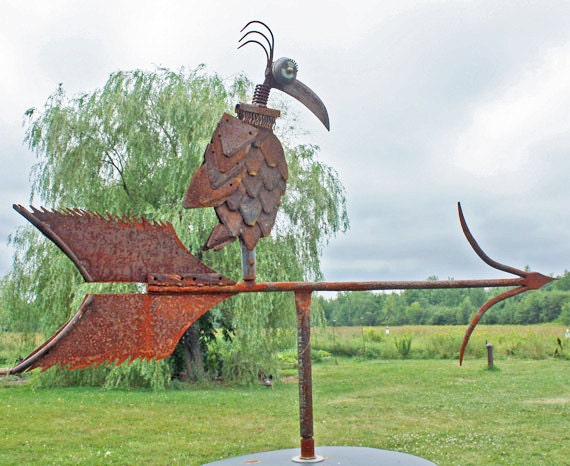
Wild Bird Weather Vane
Meteorology is a tricky business. We've all been frustrated by the TV weather man for another dodgy forecast. But long before the MET Office or weather forecasters standing in front of a green screen or broadcasting over the radio, people relied on far less technological means to predict the impending weather. Quite often, this involved observing the behavior of animals and correlating that to the weather that would follow. Cows lying down? Must be a thunderstorm coming. Cats cleaning behind their ears? Might be rain on the way.

More relevant to our purposes, included in many of those observations were birds. For example, an old wives’ tale states that if birds feed during a storm, the rain will continue for a long time – but if they don’t, then the rain will end fairly quickly. But are our feathered weathermen any more reliable than a multi-million pound satellite? But perhaps more specifically, are they reliable at all?

Yes they are - and theses techniques have been around for a lot longer than than the space-age technology we use today.

Most birds have what’s called the Vitali organ, a special middle-ear receptor that can sense extremely small changes in atmospheric pressure. With extreme sensitivity comes equally acute pain reception, so the faster the atmospheric pressure falls (indicating an approaching storm), the more birds that fly low (and the lower they fly) to the ground in an attempt to alleviate the discomfort caused by the pressure change in their ears at higher altitudes. They don’t have to be flying to escape the pain either – if you notice a sudden and sharp increase in activity at your bird feeders or a massing on power lines, there’s probably a good chance that a storm is bearing down on your location. Conversely, if you notice that birds are flying high up in the sky, the weather is most likely clear.

The height at which birds are flying isn’t the only way you can use their actions to try and predict the weather. With a storm approaching, seagulls usually take a break from flying and seek refuge somewhere along the coast to wait the bad weather out. And all kinds of birds usually become very quiet right before it begins to rain.

So while birds may not be able to alert you to tomorrow’s temperature or if there’s going to be a frost overnight, they can still be useful and practical meteorological aids. But as for that old wives’ tale that you can determine the relative length of a period of rain by whether or not birds feed in a storm, there seems to be no hard evidence that either confirms or denies its premise.

Are you a farmer that relies on wild birds to help with your harvesting or crop sewing? Do your garden feeders get busy or quiet during different weather conditions? We'd love to hear from you if you've got a story or scientific evidence that you'd like to share with us.

www.wildbirdfood.uk.com sells high quality, low cost wild bird seed and feeders direct to the UK public from our website and our store in Deeping St James, Peterborough.

Monday, 22 July 2013

What's on the menu tonight?

When you go to a restaurant or open the kitchen cupboards you like to be presented with a choice of tasty, nutritious dishes to tempt your taste buds.

Well so do the wild birds that visit your garden. The size, age, species all have a baring on what your feathered friends like to eat.

In a recent article on the BBC website, Tim Harrison from the British Trust for Ornithology (BTO) said, "Basically, the thing you need to think about when providing different food for birds in your garden is that the reason why there are all these different species is because they all have slightly different requirements and they all have slightly different niches," explains Mr Harrison. "They all feed in slightly different ways and by doing that it means they're not in direct competition with each other."

Be careful when leaving kitchen scraps out - too much salt, sugar and other additives can be lethal to wild life. The graphic above gives an indication of the types of food different birds like to eat - from live mealworms for House Sparrows to Sunflower Hearts for Bullfinches - they all know what they like so you should take the time to study what types are visiting your garden and then lay on a spread that will keep them coming back.

Kennedy Wild Bird Foods sell a large range of bird seed and live food for all UK wild birds and we also have experts on hand to guide and assist you if you're not sure what you need - we're here to help.

Have a browse around our website (http://www.wildbirdfood.uk.com/acatalog/Bird_Section.html) and securely order online for next day UK delivery.

BTW - don't forget to leave plenty of fresh water in the shade during the hot summer months - your wild birds will need it for drinking & bathing in to keep themselves cool.

Tuesday, 9 July 2013

Table for two?

The species of birds that rely and visit your garden for food will totally depend on the varieties and mixtures of feeds that you have available for them to eat. 

You should always remember that your garden, your bird feeders, and the variety and quality of feeds available represent a restaurant to birds. 

Like all good restaurateurs, to ensure that your tables remain full, one must maintain a selection of the finest and most nutritious feeds available.

You might have many bird restaurants around your residence, many of which may be 'cheep' takeaways, selling high priced corn-based feeds. 

All of our mixtures are blended to ensure the highest nutritional benefits by using only the finest seeds available from around the world.

All mixtures continue to undergo a most stringent testing programme to ensure that they are totally palatable. With over twenty years continuous research we are today extremely proud of our range of mixtures. These will ensure your tables and feeders are inundated with the many wonderful species which due to modern farming methods have become so reliant upon us all for their survival.

Please visit our website to see what's on today's menu - http://www.wildbirdfood.uk.com/TheResaurantChoice.htm